











Posts tagged scanning
Trading in paper books for e-books: Is it possible?
February 5, 2012 | 2:37 pm
In my email this morning, I received a notice from Quora that I had been invited to submit an answer for the following question: Are there any services or business models in which one can trade paperback or hardcover books for digital books, without having to pay full price again? After typing my answer, I thought it was interesting enough to repost here: Not that I've ever heard of—or no model that is legitimate under copyright law, anyway. The idea has been suggested by a number of people as something that publishers should...
Review of Bound Book Scanning service, by Patricia Guth
January 4, 2012 | 1:25 am
The December holidays have passed and there’s no doubt – given the lines at the Nook counter at Barnes and Noble – that book reading has changed immensely in the last 5 years or so. Indeed, the era of the e-book is here to stay and more and more individuals find e-reading the way to go when it comes to reading convenience.
That said, many of us are still owners of vast libraries of traditional paper books that perhaps we’d like to own in some other, more convenient format. That’s where companies like Bound Book Scanning enter the picture. This New...
Public-domain digitization projects increasingly have restrictive terms of use
December 30, 2011 | 4:15 pm
Digitization of public-domain works is a good thing, right? Most literature fans would be quick to agree. However, Glyn Moody writes on Techdirt that some of the new public digitization projects have terms and conditions that seem to be right out of the dark ages. The Cambridge University’s Digital Library, for example, places strict limits on what users can do with the books—non-commercial use only, no modification, no passing it on to third parties, and so on. A number of the works in Cambridge’s library date from well before the 1710 Statute of Anne invented modern copyright, suggesting that...
Embarrassing e-book typo proves ‘shift’ happens
September 13, 2011 | 5:15 am
I had thought that I wouldn’t find an e-book typo more hilarious than “the next Jew chapters” or “arroz con polio” from the Young Wizards series. But The Guardian Books blog has found what may very well be one of the greatest typos of all time, in Susan Andersen’s novel Baby, I’m Yours. The passage in question in the e-book was supposed to read, “He stiffened for a moment but then she felt his muscles loosen as he shifted on the ground.” [emphasis mine] However, the accidental change of a “f” to a “t” (presumably in the OCR process;...
Japanese company Bookscan expands budget scanning operations to American shores
August 12, 2011 | 11:48 am
TechCrunch has a piece on a startup called 1DollarScan, a scanning and digitizing company that is offering extremely inexpensive scanning and digitizing services. An expansion of a similar operation in Japan called Bookscan, 1DollarScan’s prices start at $1 for digitizing ten photos or 100 pages from a book. I’m not sure exactly how this service will stand legal scrutiny. Consumers might have the fair-use right to scan and digitize their own books (though some will still argue vociferously against that), but it seems to me that a company that offered this service to other people for a profit is...
Google to digitize French e-books for Hachette Livre
August 2, 2011 | 10:15 pm
The Bookseller reports that Google has reached an agreement with publisher Hachette Livre to scan out-of-print French e-books. Between 40,000 and 50,000 books will be scanned, and Hachette Livre will decide which ones are made available as e-books. (I wonder if it will include any Arsène Lupin novels?) Google hopes to reach similar agreements with other French publishers. The deal took two months longer than it was supposed to, but both parties seem satisfied with its terms. A little strange, given how much acrimony there was in Europe over Google’s scanning projects not long ago....
Plustek book scanner is well behind its time
July 28, 2011 | 11:37 am
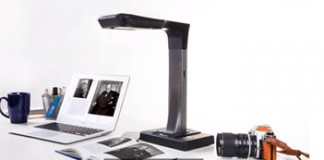
Wired’s Gadget Lab has a feature profiling a new, specifically-for-books flatbed scanner, the Plustek OpticBook 3800. The defining features of this scanner seem to be a thin bezel that allows all-the-way-to-spine scanning, and a specially padded liner to eliminate distortion. I’m actually a bit surprised that Wired is so excited over this scanner, given that in the last couple of years we’ve already seen a number of book scanning apparatuses (both do-it-yourself and commercial) that leave a one-page-at-a-time flatbed in the dust. The future of non-destructive book scanning seems to involve digital-camera rigs that can snap shots of two...
National Library of France uses private partners to digitize its collection, by Gary D. Price
July 11, 2011 | 8:16 am
From a LeMonde Article (In French, Mechanical Translation via Google):
The National Library of France announced Wednesday, July 6, launching an appeal to private partners for the digitization and enhancement of its collections. “Today is a historic step,” said President BNF, Bruno Racine, during a joint press conference in Paris with the Minister of Culture, Frédéric Mitterrand, and the Commissioner General for investment, René Ricol.
The BNF has identified 12 areas that can be scanned in partnership with private actors. These include ancient books from 1470 to 1700, a set of 300 000 French and 500 000 printed in the public domain,...
Walter Jon Williams uses pirated and crowdsourced editions to build digital backlist
May 15, 2011 | 7:37 pm
One of the downsides of piracy can also turn out to be one of its benefits in the right situation. The fact that it’s easy to scan paper books into e-books means that DRM or even refusing to release e-books can be bypassed by a suitably determined pirate. But to an author who would like to put his backlist into electronic distribution, it can be very helpful. SF/cyberpunk author Walter Jon Williams is such an author, and he reports on his blog that he was able to find scanned copies of most of his books. “So I downloaded my...
Three more French publishers sue Google for scanning books
May 11, 2011 | 11:25 am
The Bookseller is reporting that Albin Michel, Flammarion and Gallimard are suing Google for the scanning of almost 10,000 books without permission. They are demanding €1,000 per title in damages, bringing the total to nearly €9.8m.
The €1,000 per title in damages mirrors the December 2009 court award to the La Martinière group, which sued Google for the same reason, the source said. The French Publishers Association (Syndicat National de l’Edition, SNE) and the French Writers Union (Société des Gens de Lettres, SGDL) joined La Martinière in the litigation. A verdict in Google’s appeal is still awaited.
At the 2010 Paris Book Fair,...
Publisher pricing and quality issues make piracy more attractive
March 9, 2011 | 1:13 am
Audrey Watters at ReadWriteWeb takes a look at the contentious issue of e-book vs. paper pricing and whether it is likely to promote piracy. Mentioning Random House’s decision to join the agency pricing crowd, and the ongoing anti-trust investigation in Europe, she links to a Reddit thread discussing examples of e-books priced higher than their paperback or hardcover versions. The Reddit thread is kicked off by one person complaining about the prices on these books (“I love the kindle but this pricing stuff right now is making me question all of it. I have a hard time placing...
Looking back at a look ahead: My e-book piracy prognostications from 2006
December 23, 2010 | 1:57 pm
I was just looking back at a post I made in August of 2006—my first post here as a regular contributor, in fact. This came well before the advent of the Kindle, and was sparked off by a discussion of e-book piracy on the eBook Community email list. It’s interesting to look back on it in light of the sea change in e-book demand brought about largely by the Kindle, Nook, and (more recently) iPad. The article was a discussion of the relative e-piracy situations between music, movies, and e-books. My thesis was that, at the time the article...


SUBSCRIBE TO RSS