






Posts tagged digital public library of america

E-Book Usability News: Adjustable line spacing now available on the Kindle Fire HD 8.9”
May 14, 2013 | 11:30 am
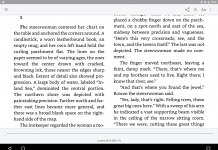
LibraryCity knocked Amazon for not letting users of the Kindle Fire HDs adjust their line spacing. But guess what I noticed just now within the font-related submenu of my Kindle HD 8.9” model running version 8.3.1 firmware?
Alas, on my several files tested, I still couldn’t narrow the spaces sufficiently on the HD even though the Kindle app for Android, as in previous versions for my Nexus 10, pulled off this trick just fine. Apologies if the HD improvement is old news, but Amazon pushes out updates automatically, and this is the first time I myself became aware of the line-spacing change. May Amazon...
Morning Links — The Digital Public Library of America has arrived
April 23, 2013 | 9:11 am
The Digital Public Library of America has Arrived (Scholarly Kitchen)
Debate Continues Over Enhanced, Interactive eBooks
(Good e-Reader)
Span Admits New Copyright Law is Designed to Keep it Off US Naughty List (Techdirt)
Should Indie Authors Reach Out to Bookstores? (GalleyCat)
Kindle Daily Deals: Pretty Little Liars by Sara Shepard (and 3 others)
...
Promising DPLA debut—but please don’t confuse special-collection items, exhibits and APIs with a full-fledged ‘public library’ demo
April 19, 2013 | 10:00 am
A caveat first. The Digital Public Library of America is evolving.
What’s more, I’m a booster of the organization and of the people behind it, including the new executive director, Dan Cohen, who so decently reacted after the Boston Marathon bombings.
But for now, the academic-and-hacker mindset is prevailing at the DPLA over the traditional public library one, judging from the demo’s worthy but rather limited debut yesterday. Not necessarily a bad thing, mind you. But then, why insist on the P word in the organization’s name?
Also, the K-12 appeal so far is not quite as great as I’d hoped despite some...
LibraryCity’s take on K-12 libraries and the DPLA
April 10, 2013 | 3:42 pm
Yes, LibraryCity has been on an S. R. Ranganathan kick lately (here and here).
Still ahead is a DPLA-related essay on his Five Laws of Library Science as applied to K-12, including school libraries—a follow-up to the LibraryCity post by Apple Distinguished Educator Donald R. Smith, a teacher-librarian with 40 years of experience. If you want to share any relevant thoughts for the next Ranganathan-inspired essay, just e-mail LibraryCity or use the comments area of this post. The essay should be online at LibraryCity.org in the next week or two, after some crucial research materials arrive.
Meanwhile, some other ideas on K-12-related matters:
The DPLA should work with state and local libraries toward the creation of a...
Beyond a Digital Attic: How the DPLA can honor the Five Laws of Library Science
April 1, 2013 | 4:48 pm
This is the era of bits and bytes and multimedia and 3D printing, not just books and other texts. But Shiyali Ramamrita Ranganathan’s Five Laws of Library Science would still apply today in spirit even after more than eighty years.
Educated originally as a mathematician, S.R. Ranganathan was a library-science genius who studied librarianship in Great Britain and worked as the librarian at the University of Madras. Accurately or not, he is said to have beaten out 900 competitors for the job. He peppered his writings with Indian philosophy, dressed Ghandi-simple, and avoided coffee and tea.
His laws, spelled out in a 1931 book available from the Hathi Trust in full text, are:
1....
Dwarf-Sized Public E-Libraries vs. Abundance
January 21, 2013 | 12:00 pm
People in Bexar County, Texas, should be excited about the 10,000-e-book “BiblioTech” library system that the country is starting from scratch—without paper books.
This is reportedly the first U.S. public library system to shun paper, cardboard and ink, except for computer printouts.
Any books are better than none, and besides, the 10K figure encompasses only copyrighted books, not the tens of thousands of free classics that library patrons will be able to read electronically. What’s more, Bexar will add to the 10,000. County Judge Nelson W. Wolff, the main brain behind the plan, deserves praise for his open-mindedness about e-books, their cost-saving potential and other advantages. Many people, especially dyslectic Americans and...
Need Library E-Books to Feed Your New Gadget? Here’s the Answer
January 1, 2013 | 9:15 am
If you can’t find the right library e-books for your new Kindle, Nook, iPad or other gizmo, you’re not alone.
More than 100 patrons of the District of Columbia Public Library were lined up electronically today for 10 e-book copies of The Racketeer, John Grisham’s new novel about the murder of a federal judge. Some 400+ D.C. library users awaited 60 electronic copies of Gillian Flynn’s Gone Girl, the best-selling fiction title on the New York Times list. And a digital version of The Casual Vacancy, by J.K. Rowling, was not even in the catalog of the D.C. public library system.
Could a well-stocked national digital library system—in...
Southern librarian’s thoughtful criticism of Gates Foundation survey unwittingly shows need for TWO national digital library systems—one public, one academic
December 4, 2012 | 9:30 am
Mindful of the record number of poor Americans, a thoughtful “Front Line Librarian” in a Southern state is asking an essential question in effect: Why care so much about library e-books and the rest when millions of low-income people lack computers or at least the skills to use them?
Front Line says more reliance on the Net will make their lives harder, not easier.
“The digital divide has not gone away,” he writes in response to my suggestion that library-lovers fill out a Gates Foundation survey on the needs of future, more digitally oriented libraries. “If anything, it is worse now than it ever has been…
“On a daily basis I...
Hurricane Sandy and the national digital library issue: With smartened-up journalists and voters, could we have stopped or slowed down global warming?
November 13, 2012 | 10:30 am
Canned and dried foods, flashlights, radios, cellphones and good UPSes aren’t the only essentials that the wired might buy in an anticipation of the growing number of weather-related exigencies like Hurricane Sandy.
I’ve also purchased a $99 battery-powered portable hotspot through which my iPad and other Wi-Fi-equipped devices can stay in touch with the rest of the world when the power goes off. In the best-served locations, optimal speeds supposedly should reach 1.4 Mbps with the company’s current technology, perhaps even making Skype possible. No need for a cellphone with tethering capabilities, and my wife and I will be able to recharge the device with...
New easy-to-use iOS app works with library-owned e-books and eliminates need for browser-based downloads
October 9, 2012 | 9:48 am
The innovative Douglas County Libraries system in Colorado has done it again—with the release of a new iOS app for iPads, iPhones and presumably Touches and the forthcoming iPad Mini.
Significantly, the app makes it a snap to check out library books, without forcing you to download through a Web browser. Talk about the path to Kindle-simple!
DCL’s Android equivalent of the iOS app was promising, but not a smooth enough patron experience when I tried it earlier this year. But DCL will be improving the Android version. And the iOS app, judging by a quick test drive on my iPad after a download of the DCL...
ALA’s gripes to publishers dance around the e-library world’s Problem #1—not enough money for e-books
September 25, 2012 | 6:48 am
I’m still borrowing e-books from public libraries. I loved the digital edition of the late Louis Auchincloss’s memoirs that popped up when I was browsing the electronic stacks of a library system near me here in Northern Virginia.
Public libraries at their best can be Serendipity Central.
But I rely much less these days on library books than before. Too often, some major e-books are AWOL from library collections or, as documented earlier this year by the Washington Post, have long waiting lists.
So I turn to Amazon, the public domain or Creative Commons titles instead.
Have I lost my enthusiasm for a well-stocked national digital library system, or, to...
Two websites illustrate the need for separate national digital library systems—public and academic
August 12, 2012 | 11:24 pm
Two good websites on learning disabilities show the need for separate but tightly intertwined national digital library systems. One system public, one academic.
Neither site is a library’s. Friends of Quinn is a grassroots nonprofit featuring Quinn Bradlee, son of Sally Quinn and Ben Bradlee—the legendary society columnist and the Watergate editor. LD OnLine is from WETA, a public broadcasting station in the Washington, D.C., area.
Friends is livelier and folksier. It’s a “must” starting point for any library patron eager to find out about a child’s learning disability or maybe her own.
LD OnLine is stodgier but more comprehensive, and many academics would favor it over Friends. Viva la difference!
In...


SUBSCRIBE TO RSS