











Other posts by David Rothman
If we can buy Alaska, can’t we purchase OverDrive for a national digital library system?
February 17, 2012 | 2:33 pm
“Seward’s Folly” was what the skeptics dubbed America’s 1867 purchase of Alaska from Russia for $7.2 million. No one had found gold in the Klondike by then. And yet America was buying a distant territory twice the size of Texas. Secretary of State William Henry Seward faced doubts aplenty on Capitol Hill.
Almost 145 years later, along with others from a workshop of the Digital Public Library of America, I walked into a slightly chilly vault at the National Archives and Records Administration in Washington, D.C., and beheld some actual paperwork from the Alaska transaction. Not just George Washington’s signature of loyalty to...
Test drive: Readium e-reading demo app off to nice start: Librarians please note
February 14, 2012 | 8:51 am
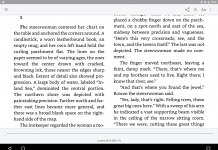
It’s only a reference app for developers and not nearly as far along as Amazon’s Cloud Reader, but I’ve got Readium‘s Chrome-browser extension running fine under the Ubuntu variant of GNU/Linux.
Click on the images for more detailed views. Download of app is here (more info here). Also see LibraryCity’s earlier post on Readium.
You can run files from your computer or Chrome-capable tablet or call them up via Web addresses, and you can increase the font font size and even choose between single and double columns. I’m not sure if the Amazon cloudreader has the column feature.
Missing from Readium, as best I can determine, is a way to...
Readium push from e-book trade group takes on Amazon—and Apple’s bastardized ePub
February 13, 2012 | 9:20 am
The name makes me think of uranium and radiation, the proprietary DRM issue remains, and Apple isn’t a supporter. But the Readium initiative, announced this morning, is a still big step forward for the International Digital Publishing Forum, the main e-book industry trade group.
A demo reader mixes ePub 3 e-book format, XML, HTML5 standards and the WebKit rendering engine used in many Web browsers.
Aided by this “reference implementation, developers will more easily be able to create ePub reading software with “support for video, audio, interactivity, vertical writing and other global language capabilities, improved accessibility, MathML, and styling and layout enhancements” (link added). Demos already exist as extensions for Chromium...
Smug about OverDrive? A whopping 39 percent of U.S. public libraries don’t offer downloadable e-books.
February 13, 2012 | 7:58 am
Hundreds and hundreds of visitors have read LibraryCity‘sproposal for the sale of OverDrive to public libraries or a related nonprofit. The idea drew favorable reaction fromThad McIlroy, a prominent publishing consultant, and it even made an ALA newsletterand Reddit.
Still not convinced of the possibilities? Well, consider that 39 percent of U.S. public libraries don’t offer downloadable e-books. Check it out for yourself. Ironic, isn’t it? Rockford, Illinois, is ODing on e-books, while many U.S. communities are so cash-strapped or e-backwards that they lack any.
Or maybe not quite so backwards. Remember, with OverDrive as a middleman, many public librarians might not feel quite as comfortable with e-books as they would...
Penguin ditches OverDrive public library side: more reason for libraries to take over the distributor for more clout
February 10, 2012 | 9:32 am
One of the giants of the book trade has unwittingly reinforced LibraryCity‘s argument that public libraries or a nonprofitshould buy the OverDrive distribution service.
Penguin said it would stop selling new books to OverDrive‘s library side.
In another OverDrive-related development, former librarian Andrew Strong, a library activist in Rockford, IL, told local officials they should consider advocating both an OverDrive purchase and a true national digital system. And he cited a current Rockford library manager’s enthusiasm for the OverDrive-related idea.
Penguin’s dissing of OverDrive and public libraries is hardly alone among publisher, as you can see from this sign from Sarah “Librarian in Black” Houghton, the acting director of the San...
An e-smart family literacy approach for Rockford, Illinois? Back to the future?
February 8, 2012 | 3:16 pm
Could children be better readers if we went “back to the future,” even in the era of e-books and calls for massive budget calls? I’ll share thoughts.
But first let’s hear from Andy Strong, a children’s librarian at the library in Rockford, Illinois, during the 1990s:
“When the library cut its hours, it drastically reduced storytime programming. In fact, service to parents and young children is a shadow of what it once was.
“In its heyday, mothers and children would leave the library with armloads and tote bags full of books. Head Start would routinely bring busloads of children to dedicated storytimes weekly, introducing new families...
Prominent publishing expert Thad McIlroy intrigued by LibraryCity’s OverDrive proposal
February 2, 2012 | 9:21 am
“Yes, it’s time to put the ‘public’ back in ‘Public Libraries.”
So says Thad McIlroy, a prominent publishing consultant, about LibraryCity’s proposal for OverDrive to sell itself to America’s public libraries directly or to a nonprofit serving their interests. McIlroy has worked for clients ranging from Apple and Adobe to Thompson Learning (now Cengage) and knows business and technical details of e-books.
"As you make clear," McIlroy writes today in a LibraryCity comment, "Overdrive is a great company that has performed admirably for years and is justifiably much beloved of the library community. But I think that it is caught in an...
Time for OverDrive to sell itself to America’s public libraries? Any foundation angels care to help?
January 30, 2012 | 11:05 am
OverDrive—the leading supplier of popular e-books for America’s public libraries—should sell itself to its library customers or at least think about it if they are willing and able to buy.
In Rockford, Illinois, a much-needed controversy rages about the local library system’s spending almost a quarter of this year’s $1.2 million acquisitions budget on e-content from OverDrive. Will the nonelite suffer in a recession-battered city of 153,000 with high rates of poverty and joblessness? How many low-income people own e-readers, and can 50 or 100 loaner Kindles really do the trick?
But what about a related question—whether a private company should lord...
E-book strategies for Rockford, Illinois: LibraryCity’s guest column in local daily
January 30, 2012 | 9:28 am
The Rockford (Illinois) Register Star, the local daily, has just published LibraryCity’s guest column: How to Make Rockford an E-Book Leader.
Rockford’s library planners are right that e-books deserve a higher percentage of their budget than now.
But the city should take care to digitize properly before going on a major e-book spree. How about such issues as access for low-income people? Or serious questions about the sustainability of current e-lending models—which a well-stocked national digital library system could help address?
LibraryCity’s article in the Register Star also suggests the creation of an open-membership citizens advisory group. It could offer advice on a...
Low-income people vs. e-books? Controversy shows why DPLA should care more about the needs of the nonelite
January 20, 2012 | 6:28 pm
Well, it was bound to happen sooner or later, and I’m glad it did. The local NAACP and others in Rockford, Illionois, are protesting the local library system’s plans to spend about a quarter of its $1.19-million collection budget on e-books. And I can understand the anger of the low-income protestors, who fear they’ll lack the resources to enjoy the digital books. Making 50 Kindle e-readers available for loans—what the library system proposes, according to a report in American Libraries—won’t be enough. The number is pathetically small, given that more than a fifth of Rockford’s 153,000 people live in poverty. Complicating matters is...
Ten ‘musts’ for an e-library ecosystem—to fight off bullying by content-providers and respect traditional library priorities
January 20, 2012 | 8:58 am
Libraries will lose out to profit-crazed publishers and other content-providers unless they can offer something back—beyond their current audiences. Penguin‘s refusal to provide new audiobooks to libraries is just part of an ugly pattern of bullying from the commercial side. Another, of course, is HarperCollins’ requirement that libraries loan an e-book no more than 26 times without paying for more reads.
TheVerge’s Josuah Topolsky on Amazon’s Fire
How to respond? Earlier I proposed alibrary-friendly ecosystem for the creation, distribution, and popularization of e-books and other content of value to both the general public and specialists. I want library items for typical patrons to be...
Apple e-textbook tools to jack up education and hardware costs ultimately?
January 19, 2012 | 3:42 pm
While the Digital Public Library of America has been fixated on arcane library-and-museum concerns, Apple is unveiling an e-format that might lock in millions of teachers and students in the U.S. and elsewhere
Very possibly the new multimedia book product may ultimately jack up costs in K-12 and elsewhere.
The new format will let students rotate and explore 3D objects, among other features. That’s good. But via hardware-related exclusives, Apple for now is locking up the new related to the hilt, playing up the ease of authoring for the format.
Probable result? Higher hardware prices for schools, students, businesses and consumers than otherwise,...


SUBSCRIBE TO RSS